Mist is the most temporary subject you will ever photograph. A valley can be smothered at dawn and clear by the time you have changed lens, and the difference between a frame that works and one that does not often comes down to which light you were standing in when it happened. Blue hour and golden hour are the two windows that matter for misty landscapes, and they are not interchangeable. One offers calm and colour; the other offers direction and drama. Knowing what each will and will not do is most of the battle.
What Each Window Actually Gives You
Blue hour is the twilight before sunrise, when the sun is still below the horizon. The light reaching your scene has bounced off the sky rather than travelled straight from the sun, so it arrives soft, low in contrast and noticeably cool. Shadows are weak and barely defined. Colours sit in a narrow band of blues, blue-greys and muted greens. Nothing is lit from the side, so texture is gentle and shapes read as layers and silhouettes rather than as surfaces.
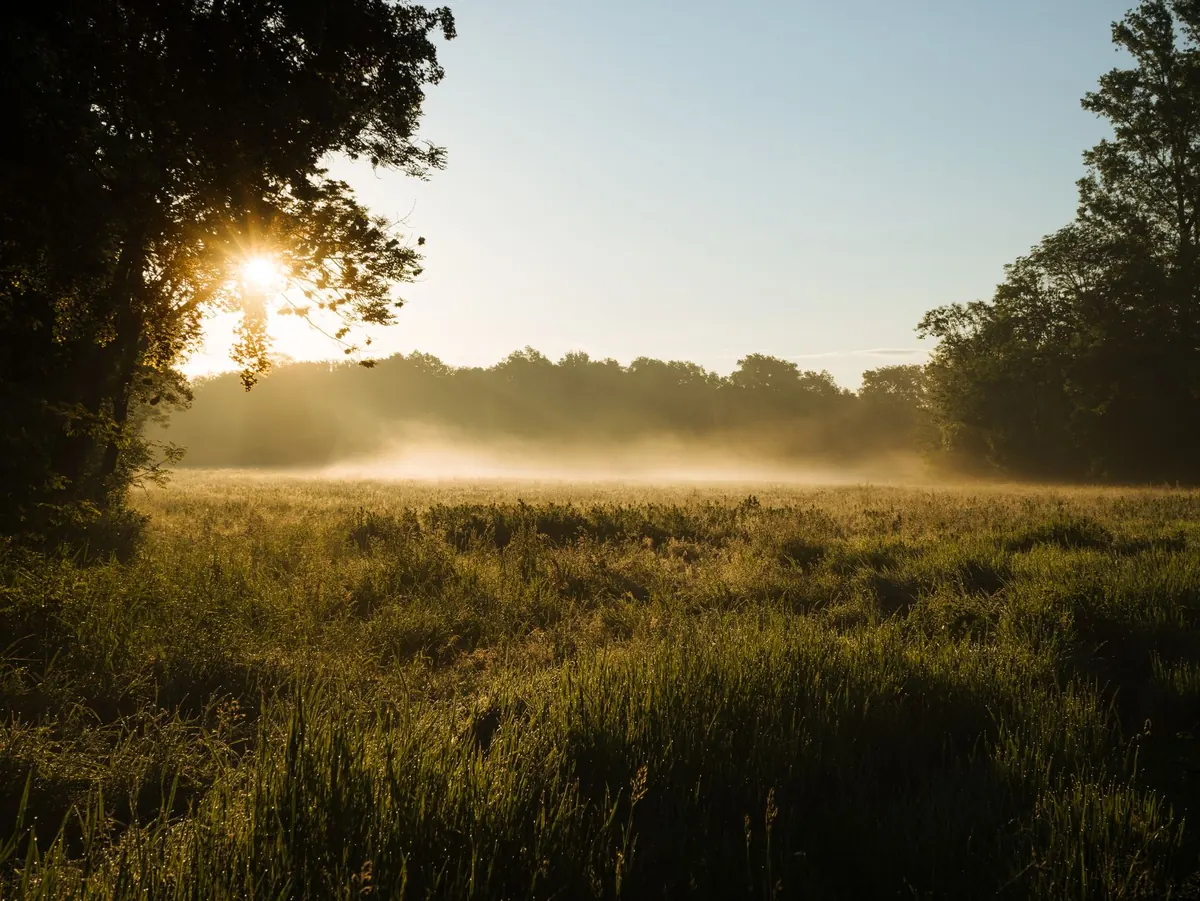
Golden hour begins the moment the sun lifts above the horizon, and for mist the first twenty minutes or so are almost always the best of it. Light now comes in at a very shallow angle, skimming the land and striking the top of the mist layer. That low angle is what separates ridges from one another, lights the edges of trees, and sometimes produces visible beams where the sun cuts through gaps in the fog.
The two windows can be twenty minutes apart. On a still morning you might photograph cool blue mist at 06:20, warm backlit mist at 06:50, and watch the whole thing lift by 07:30. That compression is why preparation matters here more than in almost any other kind of landscape work.
Colour: Cool Blues Against Warm Golds
Blue hour mist is close to monochrome. The scene resolves into pale grey-blue bands, receding into a sky of almost the same tone. Colour becomes an accent rather than a subject: an orange buoy, a red-roofed barn, the yellow of a jacket on a footpath. Find one warm note in an otherwise cool frame and let everything else stay quiet.
Golden hour hands you complementary contrast instead. Warm light rakes across the top of the mist while the valleys behind it fall into cool blue shadow, and the sky shifts from lilac to peach within a few minutes. Because mist scatters light so readily, distant colour washes out into pastel, so the strongest colour usually sits in the nearest layers.
Remember that mist dilutes saturation. It is both a diffuser and a reflector, and it will soften even the most vivid bracken or autumn beech. Do not chase richness; chase structure and let the colour arrive as a tint. Shooting raw and setting white balance later is far more useful here than trying to fix a cast in camera at 06:15 with cold hands.
Contrast and Exposure
Blue hour frames are kind to the histogram and hard on the shadows. Overall contrast is low, which means nothing clips easily — but it also means you may need several seconds at f/8 to f/11 to gather enough light. That is fine in still air and hopeless if branches are moving. The real risk is noise: underexposing and lifting the shadows afterwards produces muddy, blotchy blues that no amount of noise reduction fully rescues.
Golden hour gives you the opposite problem. Sunlight through mist can be several stops brighter than the shaded foreground beneath it. Expose for the brightest mist bank and let the deepest shadows sit low in the frame; they usually contain little of interest anyway. Check the histogram rather than the back screen, which lies convincingly in dim light. Bracketing costs nothing but card space, and a graduated filter used gently can hold back a bright sky without flattening the mist.
One rule worth keeping: never clip the brightest part of a sunlit mist bank. Blown mist has no texture and cannot be recovered, whereas shadows can usually be opened up with care.
Mood: Which Story Are You Telling?
Blue hour mist is quiet. Still water, thin reeds, a single tree, an empty lane. It suits minimal compositions with generous negative space and a low horizon, and it flatters cold subjects: hoarfrost, ice at the edge of a loch, a field of frozen stubble. The mood is contemplative and slightly melancholy, which is precisely why it works.
Golden hour mist is warmer and busier. It suits layered woodland, valleys with a river running through them, ridgelines catching first light, anything with a strong silhouette you can place between yourself and the sun. The mood is optimistic, sometimes theatrical.
Ask what the photograph is about. If it is about stillness, blue hour usually wins. If it is about light itself — its direction, its colour, the way it finds the edges of things — golden hour will give you more to work with.
A Field Checklist for Misty Dawn
- Arrive during blue hour, not at sunrise. Compositions are easier to build in flat light, and you can see where the layers fall.
- Bring a tripod and a cable release. Dawn exposures are measured in seconds, not fractions.
- Keep spare batteries in an inside pocket. Cold drains them faster than most people expect.
- Pack a lens cloth. Mist condenses on front elements as the air warms, and a smear ruins a backlit frame.
- Wear warm, waterproof layers and carry a head torch.
- Check conditions the night before: a clear sky, light wind and a cool overnight temperature are what you want, and a still valley near water is a good bet.
- Scout in daylight. Gateways, fence lines, lone trees and footbridges matter more than any camera setting.
Choosing in the Moment
- Shoot the blue hour whether or not you think you want it. It costs nothing and you only get that palette once.
- When the sun appears, look behind you before committing. The best light is often opposite the brightest sky.
- Favour backlight once the sun is up. Walk until the light is side-on or straight into the lens.
- Photograph the thinning stage. As mist lifts it reveals gaps, treetops and ridgelines, and those shapes are often stronger than the fog itself.
Working Both Ends of One Morning
Treat a misty dawn as a sequence rather than a single shot. Set up in blue hour, hold the composition through the transition, then move once — and only once — as the light changes direction. Two or three locations worked properly will beat a dozen hurried ones.
Edit the two sets differently. Blue hour files need gentle contrast and careful shadow lifting; golden hour files need restraint in the highlights and a little cooling in the shadows to keep the warmth believable. Save both, because a soft blue frame and a glowing golden one from the same valley tell two entirely different stories about the same forty minutes.
Photo: Jannis Christmann / Pexels