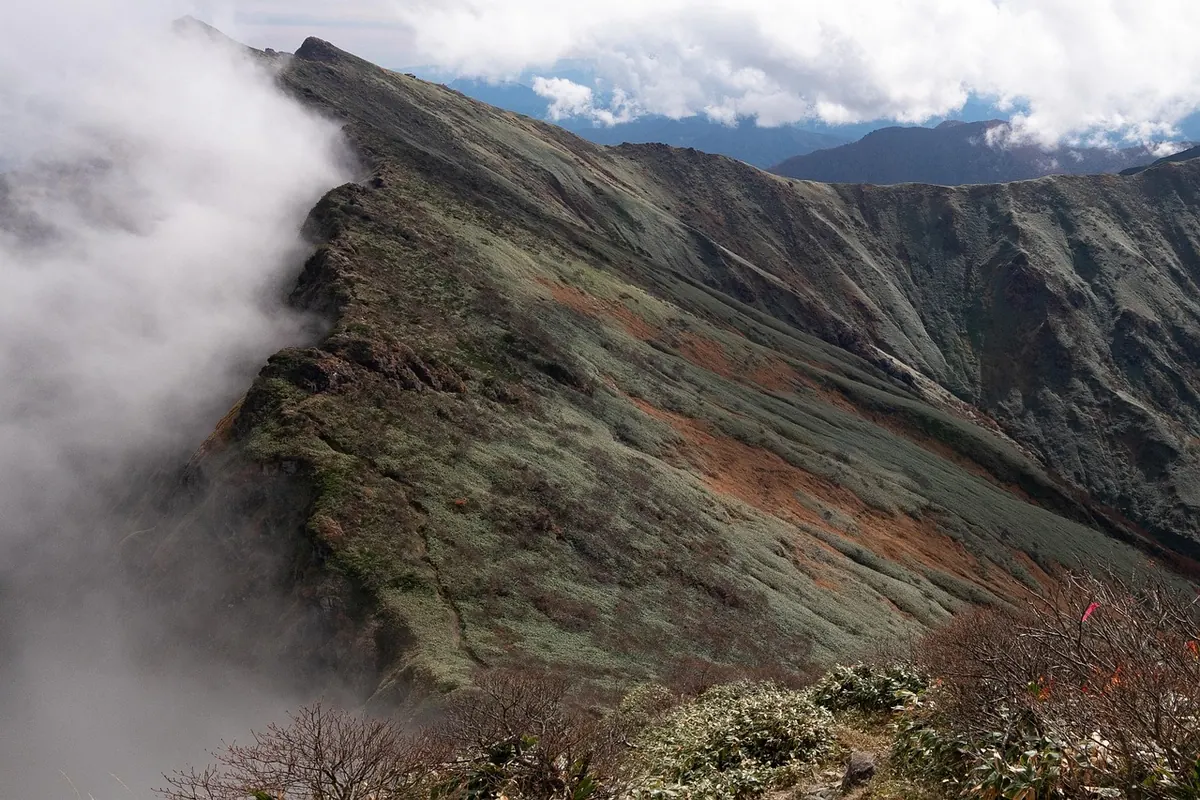
A summit gives you a single view and, in practice, two quite different photographs. One is about space: the sweep of a ridge, the curve of a corrie, the whole valley falling away beneath your boots. The other is about detail and relationship: a lone pine against a snowfield, three peaks stacked into overlapping planes, a shaft of light striking one face of a distant massif while everything else sits in shade.
Neither version is more truthful than the other. The lens you choose decides which story the frame tells, and in the mountains that decision matters more than almost anywhere else, because the scale is so vast that a careless focal length reduces it all to nothing.
Start with the story, not the lens barrel
Most of us arrive at a viewpoint and reach for a default. For years mine was a 16–35mm, because mountains look enormous and a wide lens feels like the honest way to show that. It isn’t. A wide lens shows space; it does not automatically show scale. Fill the frame with a hundred square miles of rock and cloud and you often end up with a photograph of very little at all.
So before the camera comes out of the bag, decide what the picture is about. Is it the relationship between two peaks? The texture of frost on scree? The way a valley bends out of sight? Answer that question first, then pick the focal length that makes the answer obvious to someone who wasn’t there.
What a wide-angle lens does well
Think roughly 14–24mm on full frame, or 10–18mm on APS-C. Wide-angle work is about proximity and depth: it puts the viewer inside the scene, exaggerates the distance between near and far, and turns foreground objects into strong diagonals that pull the eye inward. It is the natural choice for big weather, for reflections in a tarn, and for any composition where you want the ground to feel like it continues past the bottom edge of the frame.
The near–far frame
The trick is to get close — often within a metre — to something worth looking at, then let the mountain range sit behind it. Kneel, drop the tripod low, and check that both the foreground subject and the distant ridge are acceptably sharp. Focusing a third of the way into the scene and stopping down to around f/11 usually does it, but check the corners rather than trusting the middle of the frame.
Where wide-angle fails
Distant ridges shrink to a grey scribble. Middlegrounds turn into empty grass. Half the frame becomes flat white sky with nothing happening in it. Tilt the camera upwards and verticals lean inwards, which is fine for drama but rarely flattering to a mountain that should stand upright. And the habit of “getting it all in” produces forgettable images, because including everything means emphasising nothing.
What a telephoto lens does that wide-angle cannot
Now think 70–200mm, or 100–400mm if you carry the weight. A long lens compresses, isolates and simplifies. Where the wide lens describes a place, the telephoto describes a moment inside it. A sunlit patch on a distant corrie is a thumbnail at 20mm; at 200mm it can fill the frame and become the whole photograph.
Compression and layering
Longer focal lengths pull distant elements forward and squeeze the gaps between them. Three ridges, each a slightly paler grey than the last, become a graphic stack of bands rather than a receding muddle. This is how you show depth without needing a foreground at all — a useful skill on a bare plateau or a summit where there is nothing to stand on but rock.
Working the weather
Telephotos are also the answer when conditions are poor. Mist, rain and low cloud smother a wide view into a wash of grey, but a long lens can pick out one ridge emerging from the murk, or a single buttress catching light while its neighbours stay dark. Mixed, changeable weather often rewards the longer focal length; settled high pressure with broken cloud usually rewards the wider one.
Questions to ask before you swap
- Where is the strongest shape in the frame? If it is close and you can almost stand on it, go wide. If it is three miles away, go long.
- Is there a foreground that earns its place? If the bottom of the frame is only there because it happened to be in front of you, move closer or reach for the telephoto.
- Do you want the viewer inside the scene or observing it? Wide-angle invites them in. Telephoto holds them back, which often feels more contemplative.
- Which part of the scene has the best light? Chase that light. If it is a bright patch on one distant slope, the focal length has been decided for you.
- How much of the sky is doing anything? Blank overcast suits telephoto; ragged cloud and visible shafts suit wide.
Working both lenses in one outing
Changing lenses on a windy ridge is a reliable way to put grit on your sensor. Turn the camera off, keep your back to the wind, have the new lens uncapped and ready before you release the old one, and hold the body face down. A blower and a microfibre cloth in an outside pocket cost almost nothing and save a lot of retouching.
Weight matters too. A 70–200mm f/2.8 is a beautiful thing and a heavy one, and in the hills every kilo is paid for in sweat on the climb. An f/4 version, or a compact 70–300mm, will often serve you better simply because you will still be carrying it at the top. If you can only take one lens, read the forecast before leaving the car park and choose accordingly.
One location, two photographs
Next time you are out, pick a view and shoot it twice: once at your widest, once at your longest, with the tripod left exactly where it is. Compare the pair on screen that evening. Some will show you that the wide frame was all atmosphere and the telephoto frame was the actual picture; others will prove the opposite. Repeat that exercise through a season and the choice stops being habit and becomes part of how you see.
Take both lenses if you can carry them. But when you raise the camera, be honest about which picture you are taking — the one about space, or the one about the shape of the light on a far slope. The mountains rarely care which you choose, but your photographs will.
Photo: yoshitaka2 / Pixabay